No bugs found is not an all-clear
An exploratory run that finds nothing tells you very little until you know where it didn’t go. Why the list of what a run left out matters as much as the bug list, and what a useful one looks like.
Read the articlePractical writing on AI-assisted test design, suites that repair themselves, failures that explain themselves — and the awkward parts nobody puts in a product page.
An exploratory run that finds nothing tells you very little until you know where it didn’t go. Why the list of what a run left out matters as much as the bug list, and what a useful one looks like.
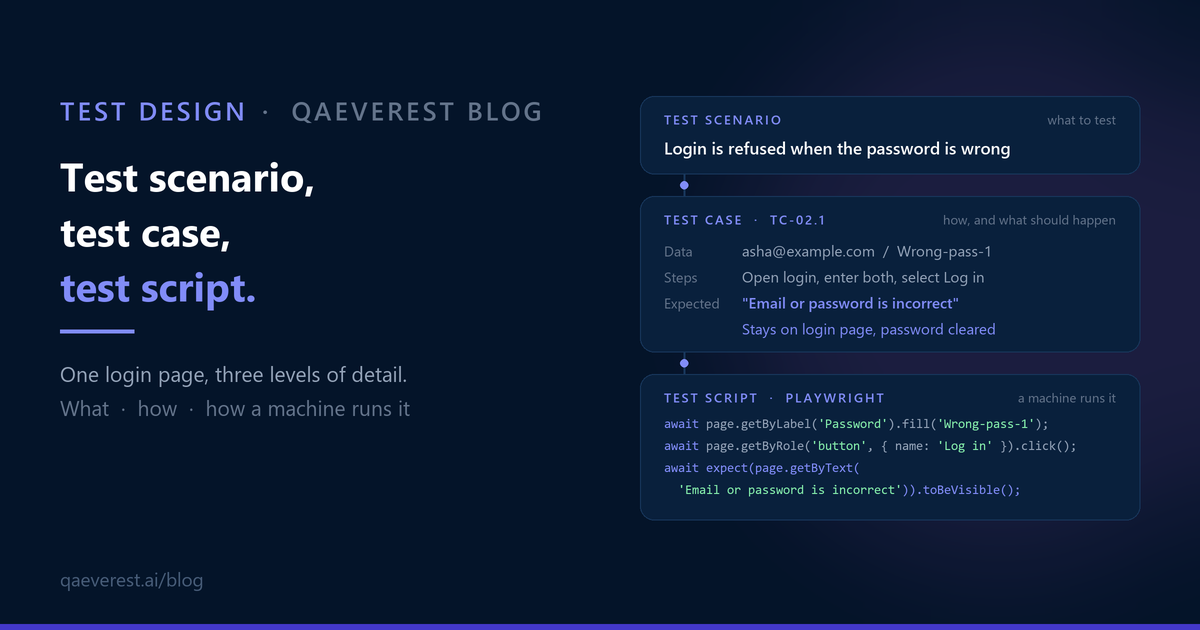
Read the articleThree terms that get used as if they meant the same thing. They don't. One login page worked through at all three levels, plus when to use each one and the mistakes that blur them.
Read moreThe card was declined, but the order was saved and the stock went down. Here is what a transaction is in plain words, three situations worth testing on purpose, and how to check the data was really rolled back.
Read moreAI can take on much of the legwork in testing while your QA team makes the calls. Four hand-off points — bugs, change maps, AI baselines and recommended test sets — and what each one should hand your team.
Read moreQAEverest accepts your requirements in eight forms, from user stories and Jira tickets to Swagger specs and recorded flows, drafts the test cases, and lets your team review and approve what moves to automation. Here is how the three-step workflow turns a requirement into a running, cross-browser test suite.
Read moreMost teams make their first QA hire later than they planned. Here's how to cover the real risk in the meantime — and how to set things up so that first hire starts with a head start instead of an archaeology project.
Read moreAsk it about any test in your suite and the room goes quiet. The data to answer it exists — it just lives in three systems that were never joined. Here's what joining them unlocks, from coverage gaps to scoring a pull request by risk.
Read moreMost UI tests spend their first two minutes creating data through screens nobody is testing. Do the setup with an API call, test the screen that matters, clean up with another call, all in one test case.
Read moreEvery suite has one: green the first time it ever ran, red every time since. Test data is the quiet reason automation stops being trusted — here are the four approaches teams take, what each one really costs, and the questions that decide which you need.
Read moreA comment your team wrote to each other eight months ago is now a sentence in a prompt. No attacker is required for that to go wrong — and the payload that matters is not the loud one.
Read moreIf you grade an AI agent with another model, remember what a red-team reply is: output from a system that is currently being attacked. Here is how a compromised agent talks its way past its own evaluation, and what a judge has to do to stop it.
Read moreMoving an automation suite into a new platform is a five-minute job that produces something useless. The interesting problems are page objects, and the helper calls nobody can follow — including what a tool should do when it can’t.
Read moreSixty-eight test cases, five identical setup steps each. Then the button changed. Here's the fix, and the three things we got wrong on the way to it — including the one that logs your user in twice.
Read moreA missed bug costs you one bug. An imagined one costs you the whole findings list. What we changed after the criticism landed — and the three questions worth asking any tool that reports bugs nobody asserted on.
Read moreA Thursday afternoon, a null check, and eighty-two minutes of waiting. The pull request already knew which tests mattered — here's what happens when something finally reads it.
Read moreNot the licence fee. Not the CI bill. Here's the arithmetic behind automation maintenance — and the one input that triples it.
Read moreEvery AI testing tool quietly asks you to start over. Here's why the 2,000 tests you already have are the strongest argument against that — and what actually survives an automated migration.
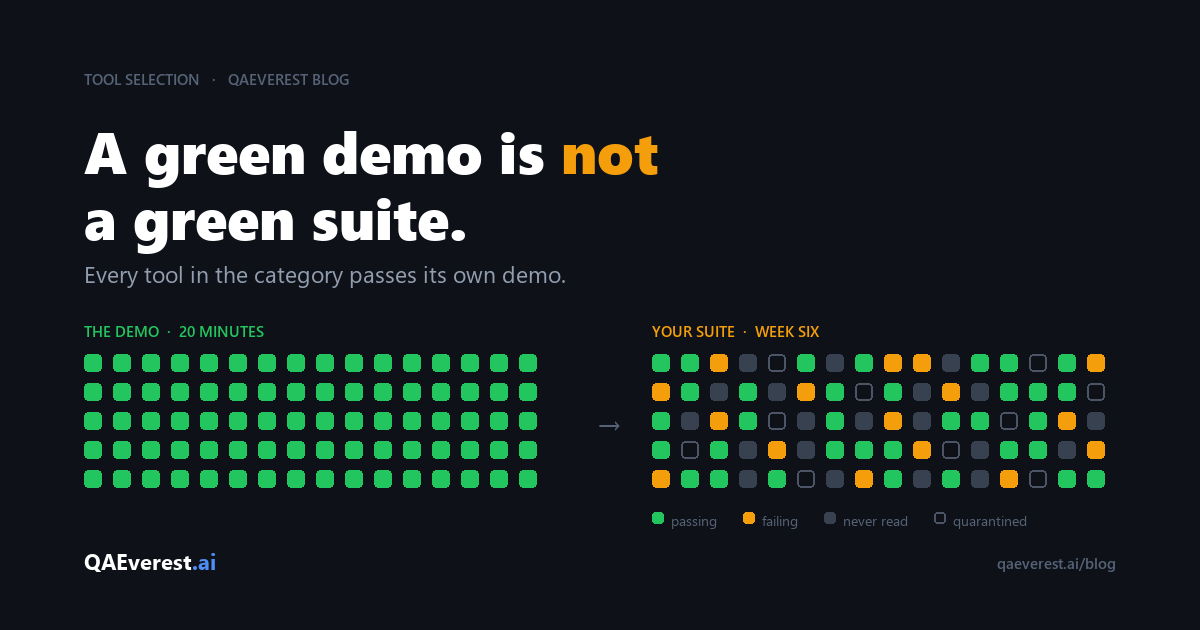
Read moreTwenty minutes on a clean sample app, and they all go green. What to ask instead — and the four days that tell you what week six will feel like.
Read moreA designer renames one button class. Nine tests go red and not one of them found a bug. The four mechanisms that turn that Tuesday into your automation programme's real cost.
Read moreNobody's suite breaks at 500. It just quietly stops paying for itself — and the arithmetic behind that is harsher than any business case assumes.
Read moreEvery QA tool evaluation scores features. None of them score the only thing that decides the outcome — whether anyone will open it on an ordinary Tuesday.
Read moreYou were never a manual tester — you were a test designer who also had to be the execution engine. Only one of those halves got automated, and it wasn't the valuable one.
Read moreWhich part of test design actually collapses, which part shouldn't, and why the second half of that sentence is the harder engineering problem.
Read moreIt isn't one problem. It's four — and almost every tool on the market fixes one of them, then hands you the other three.
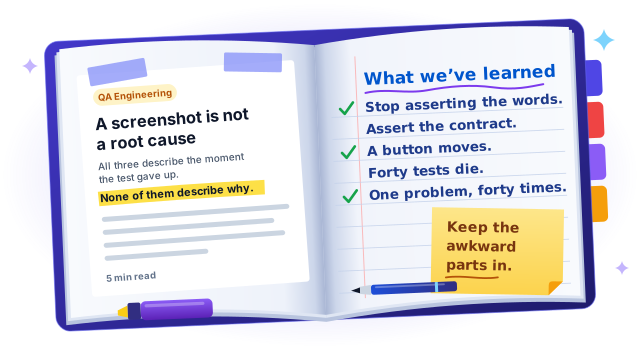
Read moreWhy the artefact most test tools hand you at the moment of failure is the one piece of evidence that can't tell you what went wrong — and what replaces it.
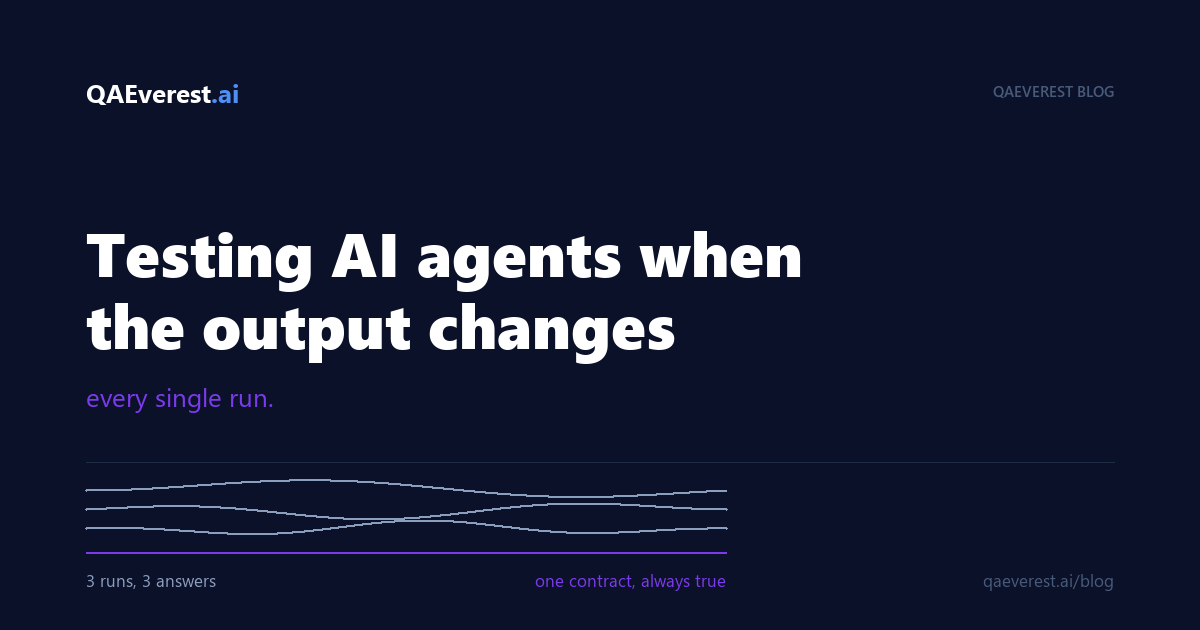
Read moreAssertion-based testing assumes a deterministic answer. LLM-backed features don't have one. What you can still hold them to — and how to keep the bar from drifting.
Read more