The job description asks for Selenium, Cypress, API automation and CI/CD, and somewhere near the bottom it says "coding skills mandatory." Nowhere does it ask whether you can look at a payments story and spot the refund edge case nobody wrote down. You've spent nine years finding the bugs nobody else finds, and the ad doesn't have a checkbox for it.
That's not because the skill stopped mattering. It's because it's hard to screen for and hiring has always drifted toward what's easy to measure.
This piece is for the tester reading those ads at eleven at night, wondering whether the market has quietly decided they're obsolete. The straight answer: it hasn't. But it has repriced some skills, and it is badly mispricing others in a way that's about to swing in your favour.
You were never a "manual tester"
Strip the label off and look at what the job actually was. You read a requirement, decomposed it into paths, boundaries and negatives, judged which risks were real, decided what was worth checking and then, because someone had to, you also executed those checks by hand. Two jobs, one title. A test designer, doubling as the execution engine.
What's changed is that the execution half is increasingly done by machines. Honesty matters here, so let's not dress it up: roles that consist only of working through pre-written steps and marking pass/fail are shrinking, and they will keep shrinking. If that's the entire role, the ground really is moving.
But look at which half got automated: the half that never needed your judgement in the first place.
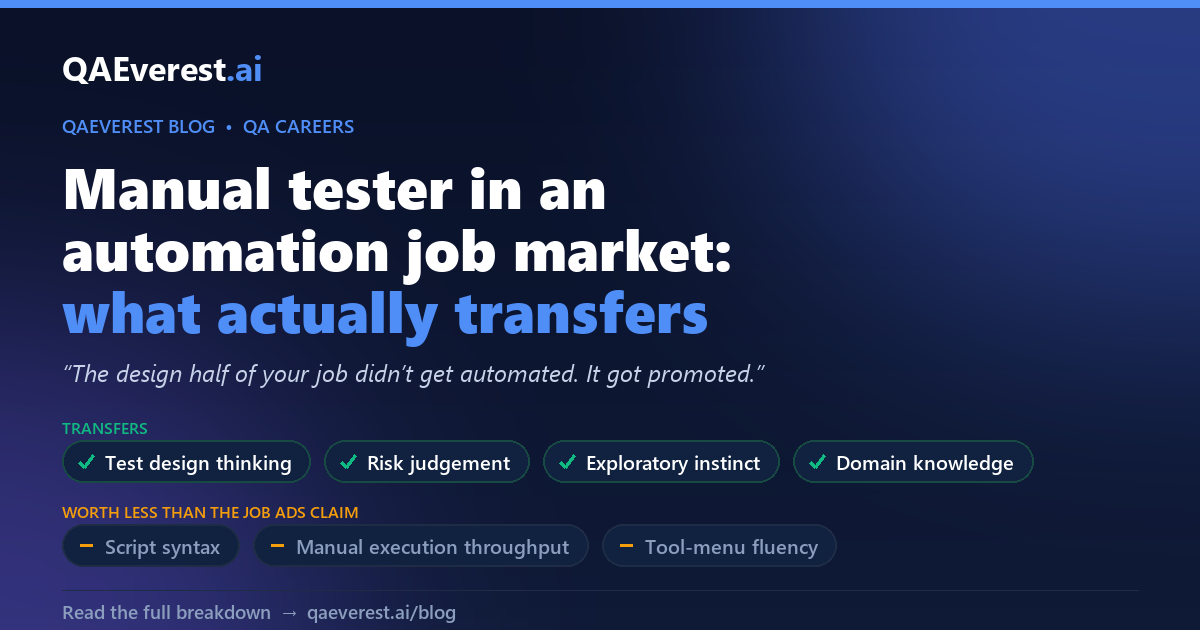
The design half of your job didn't get automated. It got promoted.
The market is screening for the wrong moat
Now the part almost nobody says out loud: the skill being commoditised fastest right now isn't manual testing. It's automation code.
An AI model will write a page object, a locator strategy and a retry wrapper far more reliably than it will notice that a story is missing its refund path. Script syntax is exactly the kind of pattern-shaped, well-documented work that AI generation is best at and it's being commoditised faster than test judgement by a wide margin.
The moat was never the syntax. It was knowing what to test and the industry spent a decade confusing the two, because syntax was easier to screen for in an interview.
Which makes those job ads quietly ironic. The "mandatory" skill is depreciating faster than the one they left off the list. A tester grinding through WebDriver waits in 2026 is sprinting toward the spot where the wave already broke.
What's worth learning — and what the standard advice gets wrong
"Learn to code" is the advice everyone gives, and as usually delivered it's mis-aimed. It sends testers off to grind through a Java course as if the goal were becoming a junior developer which it isn't, and which plays to none of your strengths. The realistic target is narrower and much more reachable:
- - Learn how automation fails, not how to write frameworks from scratch. Brittle locators, race conditions behind flaky waits, test data drift. Your future job reviews and directs automated tests; knowing their failure modes is the qualification.
- - Read code well enough to review it. Following a Playwright test and spotting that it asserts the wrong thing is a fraction of the effort of writing one blind and worth more.
- - HTTP and API basics. Requests, status codes, payloads. It's where bugs surface first, and it's a fortnight of evenings, not a degree.
- - Learn to direct generation tools. The emerging interview question isn't "write a fluent wait." It's "here are 200 generated tests which 20 matter, and what's missing?" That is a test-design question wearing new clothes, and it plays directly to your strengths.
What this doesn't fix
Worth saying plainly, because the limits are where trust is earned:
- - Résumé screening still keyword-filters. Judgement doesn't parse from a CV. You'll likely need the retitle QA Engineer, not Manual Tester and the tool names, just to reach a human who can recognise the rest.
- - Some markets are simply brutal right now. Headcount is headcount; no framing changes it. What you control is whether you're competing on the skill being commoditised or the one becoming scarce.
- - The transfer isn't free. The list above is months of deliberate evenings, not a weekend. Shorter than becoming a developer but not zero, and pretending otherwise is how bootcamps sell courses.
Why the leverage is moving toward you
Ten years ago, a tester with brilliant risk instinct and no Java was locked out of automation entirely the syntax was the toll gate. That gate is coming down: modern tooling (ours included) turns a well-refined story into generated cases and an executing suite with no framework code standing in between. When the syntax layer thins out, the leverage moves to whoever knows what to test.
That was always your half of the job. So the question to sit with isn't "can I learn Selenium fast enough?" It's "when the machine does the testing, who reviews the machine?" Someone has to look at generated coverage and say what's missing, what's noise, and what the story never mentioned. That job has your skills written all over it; it just doesn't say "manual" on it anymore.


