Requirements Traceability — Frequently Asked Questions
What is the Traceability feature in QAEverest?
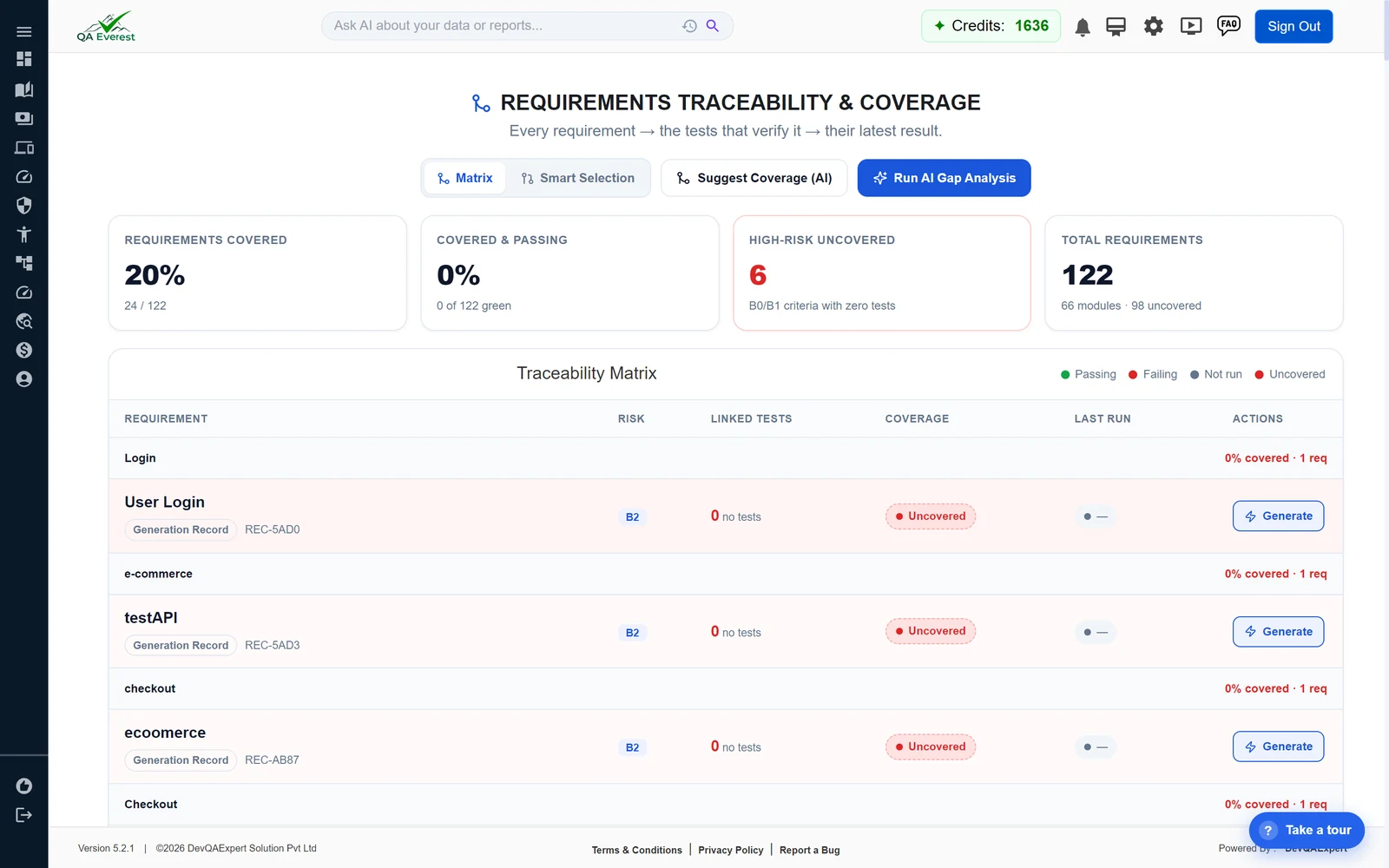
Traceability is a Requirements Traceability Matrix (RTM) that links every requirement to the test cases that verify it and shows their latest result — "every requirement → the tests that verify it → their latest result." It gives you a single view of coverage, highlights high-risk gaps, and adds AI gap analysis and PR-scoped smart test selection.
Where do the requirements in the matrix come from?
The matrix pulls requirements automatically from your existing QAEverest data — there is no separate import step:
- Refined Stories from Story Refinement (referenced as
SR-XXXX). - Generation Records created when you generate test cases (referenced as
REC-XXXX). - Jira Issues you have imported, shown with their issue key (e.g.
QA-17).
Links are stored in a separate, non-invasive collection, so nothing is changed in your existing stories or records — the mapping is fully reversible.
What does the traceability matrix show?
The Matrix tab opens with four rollup cards — Requirements Covered %, Covered & Passing %, High-Risk Uncovered, and Total Requirements. Below them, requirements are grouped by module (weakest coverage first) in a table with these columns:
- Requirement
- Risk (business-risk tier)
- Linked Tests
- Coverage (Covered / Uncovered)
- Last Run (Passing / Failing / Not run)
- Actions
Any uncovered requirement gets a Generate button that jumps into the test generation flow with the requirement pre-filled.
What are the business-risk tiers (B0–B3)?
Each requirement is assigned a risk tier — B0 Critical, B1 High, B2 Medium, or B3 Low. The tier is derived from the business risk of its linked test cases (worst case wins) or falls back to the story's priority. The High-Risk Uncovered card counts B0/B1 requirements that have no tests at all — your most important gaps.
What is in the per-requirement coverage report?
Clicking a matrix row opens a full-page Requirement Coverage Report showing summary KPIs (coverage, linked test count, last run, business risk), the acceptance criteria with an estimated criterion-to-test keyword match, the requirement story text, the trace lineage, and a Linked Tests table (test, status, suite, risk) with a coverage health bar, status filter, and search. If the requirement is uncovered, a coverage-gap callout offers a "Generate tests for this" shortcut.
What is Smart Selection for GitHub PRs?
The Smart Selection tab lets you paste a GitHub Pull Request URL and get back the minimal, risk-ranked set of tests to run for that change. It reports how many tests to run, the percentage of risk covered, the estimated minutes saved versus the full suite, the touched requirements, and any changed files it could not map to tests (RTM blind spots). You can tick tests and run the selected set directly.
What does AI Gap Analysis do and what does it cost?
Run AI Gap Analysis produces an AI narrative for your coverage — a verdict (critical, warning, or pass), a summary, the top risk-ranked uncovered gaps, and recommended actions. If the AI service is offline it falls back to a deterministic heuristic narrative. Gap analysis costs 2 credits per analysis.
Which traceability actions are free?
Viewing the matrix and per-requirement reports is free. Suggesting coverage links with AI, accepting or rejecting suggested links, manually linking or unlinking tests, and running Smart Selection on a PR are all free today. Only the AI Gap Analysis(2 credits) is credit-gated.