Exploratory Testing — Frequently Asked Questions
What is Exploratory Testing in QAEverest?
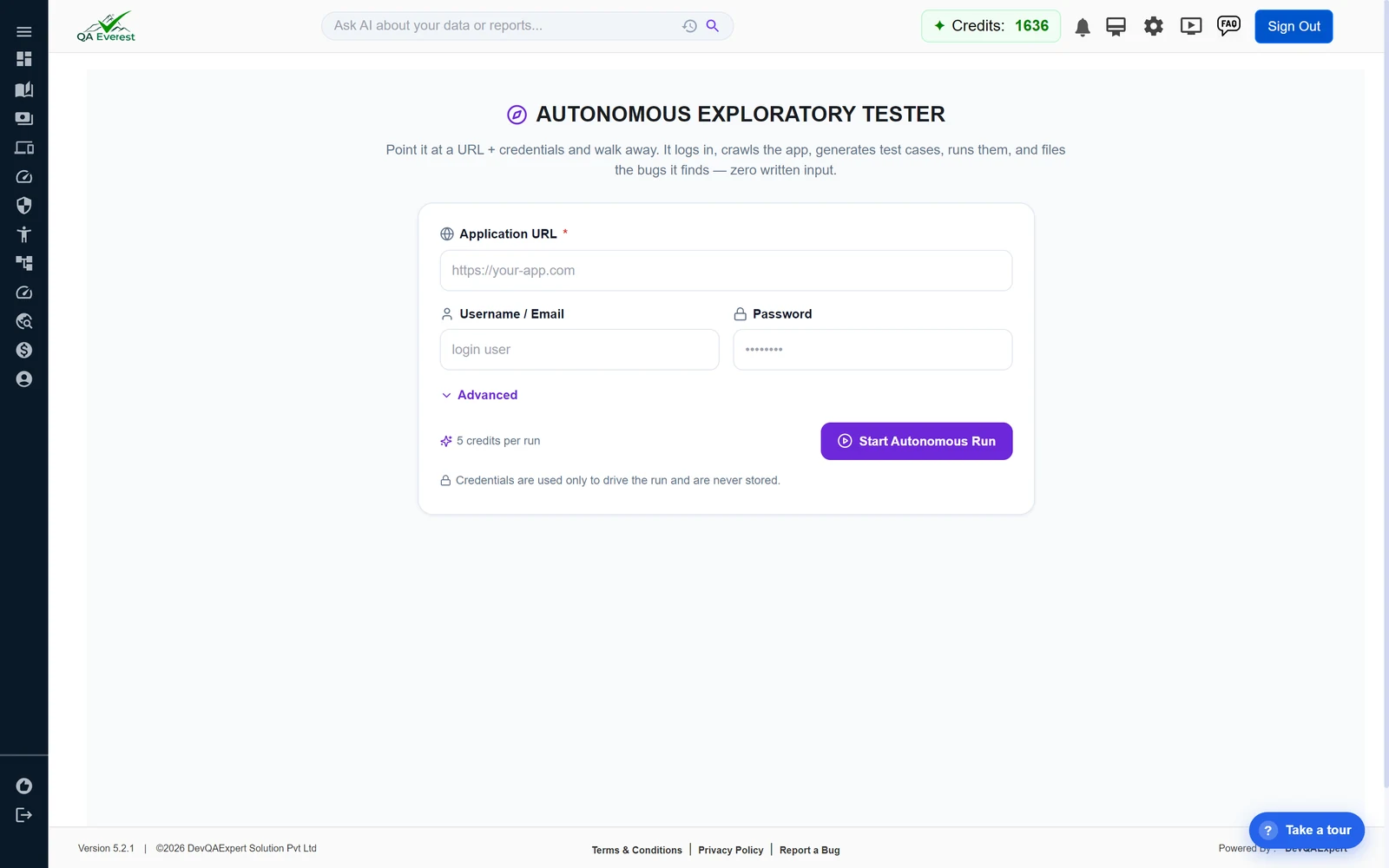
QAEverest's Exploratory Testing is an Autonomous Exploratory Tester. You point it at a URL (with optional credentials) and walk away — it logs in, crawls the live app, generates test cases, runs them for real, and files the bugs it finds, with zero test scripts written by you.
What are the phases of an exploratory run?
Each run works through five sequential phases:
- Login — opens the URL in a real browser, finds the login form, signs in, and verifies success. Apps with no password field are treated as public and skip straight to crawling.
- Crawl — breadth-first crawl of the same origin only, recording pages, links, buttons, inputs, and forms. A destructive-action filter avoids following logout, delete, or cancel links.
- Discover Flows — AI synthesizes up to six Gherkin flows from the crawl map, with a deterministic heuristic fallback if AI is unavailable.
- Execute — runs each flow in a real browser, reusing the authenticated session.
- Triage Bugs — AI analyzes each failed flow into a structured bug candidate.
How do I start an exploratory run?
- Open Exploratory from the sidebar.
- Enter the Application URL (must start with
http://orhttps://). - Optionally add a username/email and password for protected apps, and adjust the advanced options — max pages to crawl (1–25, default 8) and max crawl depth (1–4, default 2).
- Click Start Autonomous Run. The page shows a live phase stepper, progress bar, and counters for pages crawled, flows generated, passed, failed, and bugs found.
What does an exploratory run produce?
- Discovered flows — each an expandable Gherkin feature tagged as AI- or heuristic-generated, with pass/fail/not-run status.
- Execution rollup — passed, failed, and total counts.
- Bug candidates — each with a title, severity, expected vs actual behaviour, reproduction steps (the Gherkin), and a screenshot on failure.
- Run history — a "Recent runs" list of your last runs with URL, pages, pass/fail, and bug count.
How are bugs classified, and can I file them?
Every bug candidate is given a severity of Critical, High, Medium, or Low. You can file any bug with one click to Jira (using a project key) or ClickUp (using a list ID). Once filed, the card shows the issue key with a link, and the same bug can't be filed twice from one run.
Is my login information safe?
Yes. Credentials are passed securely to the testing agent and are never stored — only a masked username (for example "Ad***") is kept with the run record, and the password is never saved.
How many credits does an exploratory run consume?
Each autonomous exploratory run consumes 5 credits, regardless of how many pages are crawled or flows are generated. You can still view the Exploratory page and your run history without an active plan — only starting a run requires a subscription and sufficient credits.